Question: Today there are No King rallies with chanting and marches and tomorrow is Palm Sunday with procession and singing a hymn. Why are marches and processions with singing such powerful political and liturgical experiences?
Answer: Yes, today crowds in every state are gathering to protest the kingly pretensions of our current president. The U.S. was founded on the principle of “no king.” We are a constitutional republic with three equal branches of government. Historically, from the beginning U.S. history has resisted the chief executive, the president, having kingly titles and being “above the law.” George Washington declining to run for the third term, renounced the powers of office, and returned to farming at Mount Verrnon. This blew the mind of King George III. When it was reported to him he said, “If he did that he is the greatest man who ever lived.” Mr. President lives in a House, not a palace. And it’s why millions of Americans rally and march under the banner of “no king.” NO KING ABOVE THE LAW LIVING IN A GOLDEN PALACE.
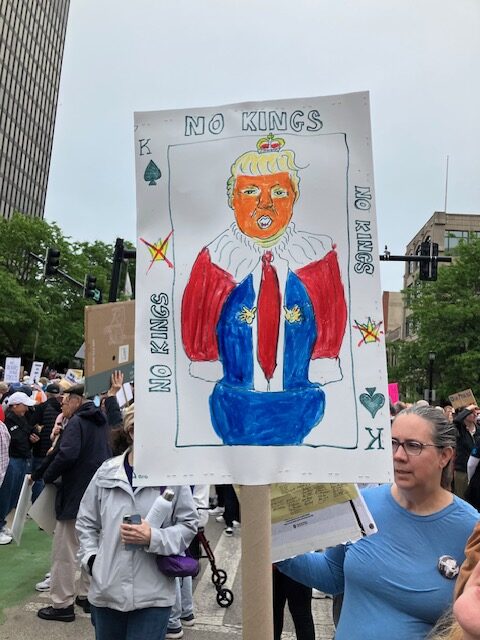
In Evanston, IL in 2025
Tomorrow is Palm Sunday. In churches around the world the faithful will gather outside for a palm procession leading into the church building sing the medieval hymn, “All glory, laud, and honor to thee redeemer king,” to reenact the entry of Jesus into Jerusalem at the beginning of Holy Week. Waving palm branches signifies the hailing of a messiah. The people in Jerusalem chanted “Hosanna (save us) David’s Son” as Jesus entered the city, proclaiming him as the rightful successor to the greatest king of Israel. Christians who participate in “no king” rallies and marches will tomorrow hail Jesus as “the Lord’s anointed,” their king, and in the liturgy show their allegiance to him.
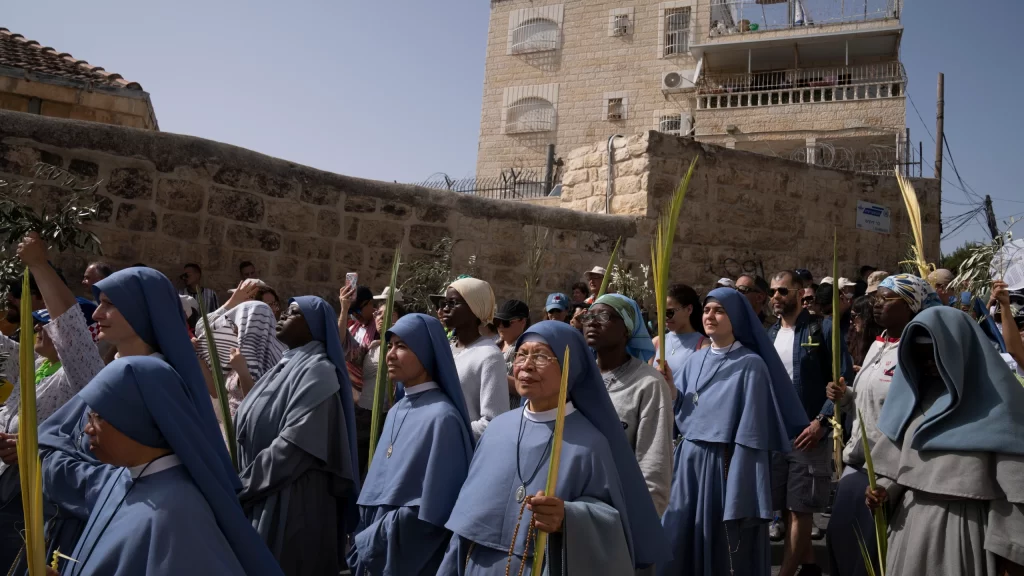
Here is a Palm Sunday procession in Jerusalem where the custom originated in the fourth century, as described in Egeria’s Pilgrimage Diary.
But you ask why marches and processions, chanting and singing together, are so effective as political and liturgical events. As we say, there’s science behind it: the physical principle of entrainment. Entrainment is two or more entities being attracted through vibrations. It requires motion to produce vibrations. The ear picks up these vibrations and communicates them to the brain, which affects consciousness. A person’s body and mind processes these vibrations as sound and engages in the pulse and rhythm of the sound within the body. We usually hear these sounds as music. Music is a very embodied phenomenon, but doing something with the sounds that one “hears” (senses) requires a relationship between the source of the sound (the music maker) and the hearer.
Entrainment has to do with synchrony, like a band marching together in time, or a choir of individuals singing together as one unified group. Those who march together or sing together are attracted to one another because the brain releases the hormone oxytocin, which engenders feelings of trust of the people around us. This hormone is also released when two people have sex with each other. See Daniel Levitin, This Is Your Brain on Music: The Science of a Human Obsession (Penguin 2006). But bonding occurs in group rallies and parades and marches. This affects both political gatherings and liturgical processions.
To look at the big picture of the development of human society, Georgian ethnomusicologist Joseph Jordania, in Why Do People Sing? Music in Human Evolution (Logis 2011), locates synchronized movement and chanting in human evolution and suggests that human survival depended on it. He explains that “the most archaic parts of the human brain are activated when humans sing or listen to music,” and this had a survival function for our ancestors. In his sweeping study of music in evolutionary biology and sociology Jordania proposes that singing “provided our ancestors with defense against predators, provided our ancestors with food, gave rise to human intelligence, morality, religion, formed the human body and facial morphology, gave birth to human arts and the mystery of artistic transformation.”
Central to human survival was defense from predators. Homo erectus had the advantage of being able to use arms and hands separately from legs (e.g., clutching weapons while running). Humans weren’t the fastest runners, and did not have great physical strength, big teeth and jaws, or strong and tough hide. But they could make loud and changing vocalizations. Jordania’s suggestion is that “our ancestors turned loud singing into a central element of their defense system against predators. They started using loud, rhythmic singing and shouting accompanied by vigorous body movements and object throwing to defend themselves from predators.” This synchronized or entrained musical and muscular behavior coalesced into precise rhythmic chanting, which could make their loud noises even more threatening. By this means hunting parties could also scare off large beasts like lions and deprive them of their kill.
In time human groups could use this entrainment when they turned against each other in battle. Jordania proposed that this loud rhythmic singing put our ancestors into an altered state of consciousness which he called “battle trance.” Armies marched into battle and attacked with war cries. This has been domesticated today into the army marching together in time, as tourists see in London.
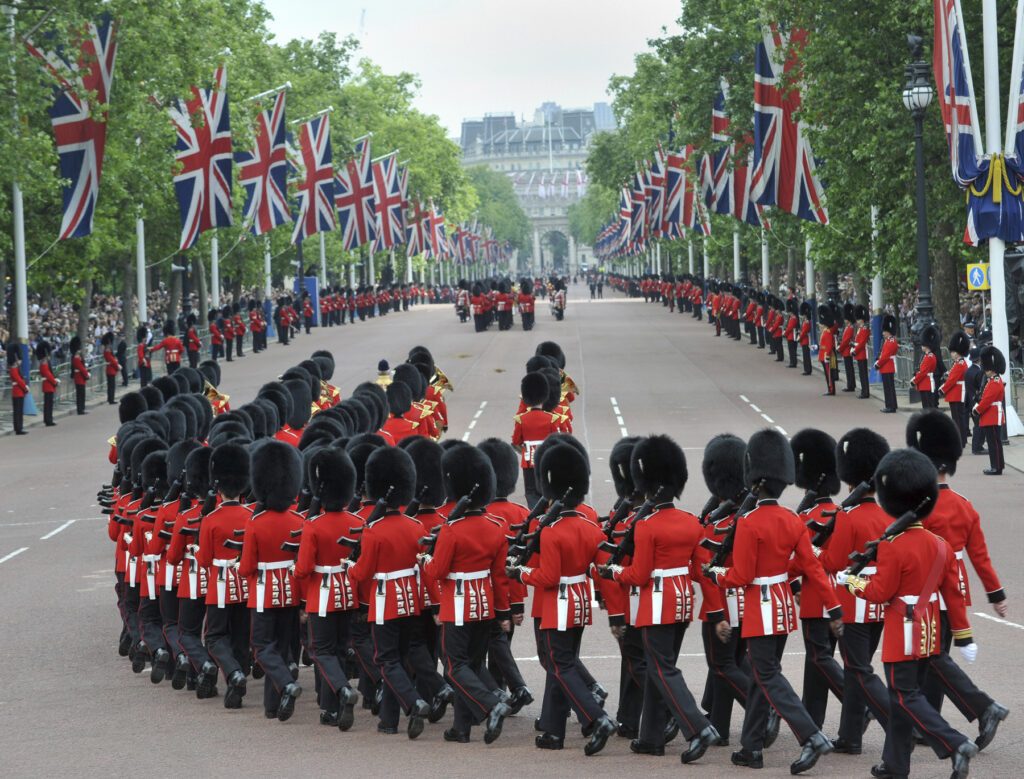
Tourists in London are impressed by miliary drills involved with the king such as the changing of the guard outside of Buckingham Palace.
Historian William H. McNeill, Marching Together in Time: Dance and Drill in Human History (Harvard University Press, 1995), adds dance to the process of human evolution. Human groups not only engaged in loud, rhythmic singing in hunting and defending themselves, but also in celebration and enjoyment of their victories. “Moving together rhythmically for hours on end can be counted upon to strengthen emotional bonds among those who take part—women as well as men.”
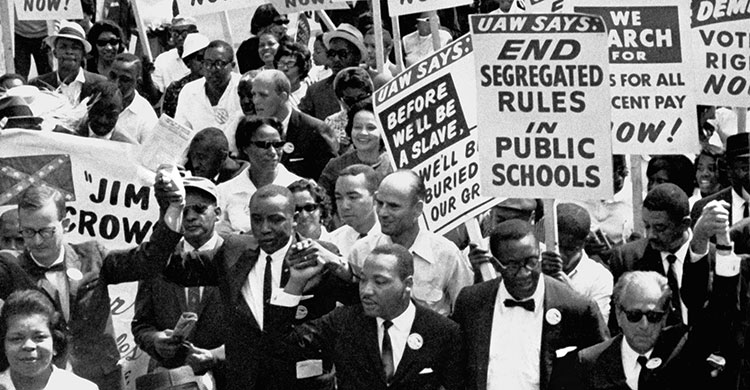
McNeill reviewed the roles of dancing in religious ceremonies and marching together in time as armies went into battle. Musical instruments have accompanied both religious dancing and military marching, e.g., flutes for dancing, brass instruments for marching. Flutes suggested undulating movement, brass instruments suggested precision movement. When marching into battle, bugles sounded the charge and drums beat the tempo of running. Whether dancing together in groups in community festivals or doing close order marching in a parade, dancing and marching are forms of what McNeill calls “muscular bonding.” These muscular movements create and sustain social cohesion. Synchronous musical, dancing, and marching experiences are powerful forms of social bonding, whether in church choirs or folk dancing or high school marching bands. We remember how hundreds or thousands of people marching together for civil rights while singing “We Shall Overcome” created a powerful experience of human bonding.
Dancing has played a prominent role in religious rituals. In the Old Testament we think of David dancing naked before the ark of the covenant when it was brought up to Jerusalem. In the festival of Simchat Torah in the synagogue, when the reading of the Torah is completed and the cycle of readings begins again, the Jewish worshipers dance with the Torah scrolls.
Christianity has historically not endorsed dancing in church as an act of worship, although that is changing in Catholic Masses in Africa and there have been notable exceptions even in America (see Frank Answers About Dancing in Worship).
But Christianity has practiced liturgical movement through processions. Many outdoor processions occurred during the Middle Ages; liturgy was not only an in-house event. Among those outdoor processions that are still observed today are:
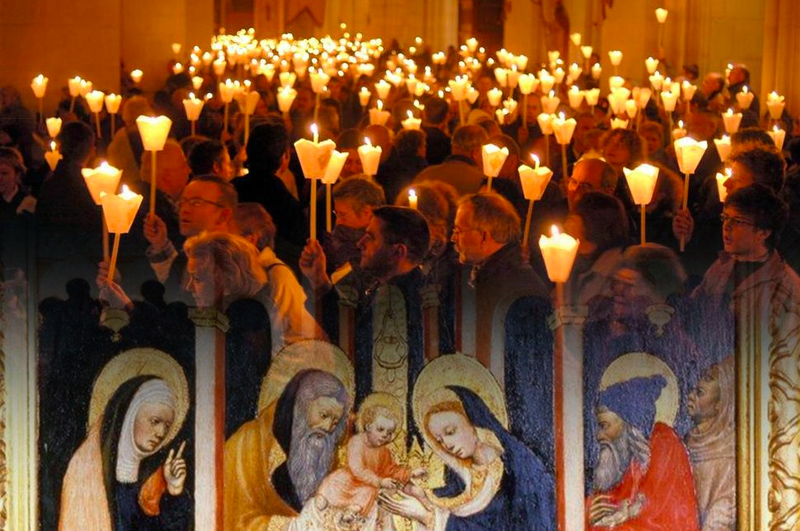
the Candlemas Procession on the Feast of the Purification of Mary and Presentation of Jesus in the Temple (February 2) which proclaims Christ as “light to the nations and the glory of his people Israel” from the Song of Simeon;
the Palm Sunday Procession with palms and shouts of hosanna;
the Via Crucis through the streets on Good Friday with Christ carrying his cross;
the Easter Vigil candlelight procession into the dark church singing “the Light of Christ. Thanks be to God”;
the Rogation Procession through the fields on the days before the Ascension of our Lord singing the Great Litany;
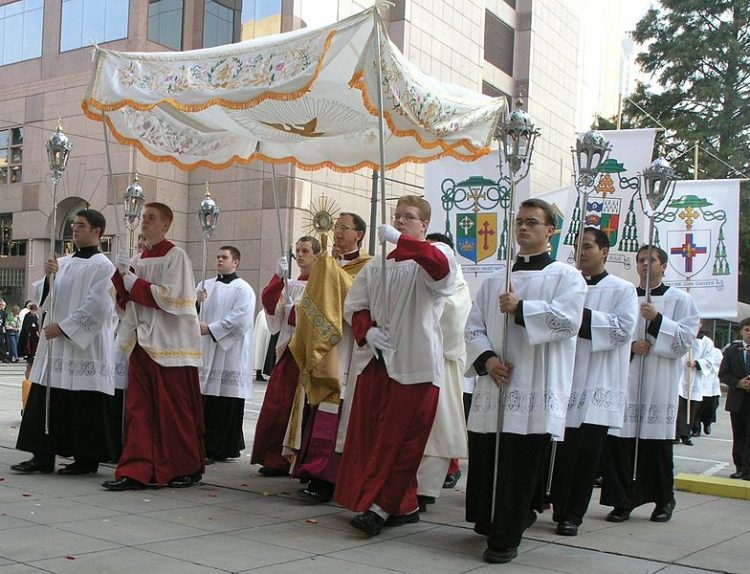
and the Corpus Christi Procession with the reserved host displayed in a monstance singing “Therefore we before him bending, this great sacrament revere.”
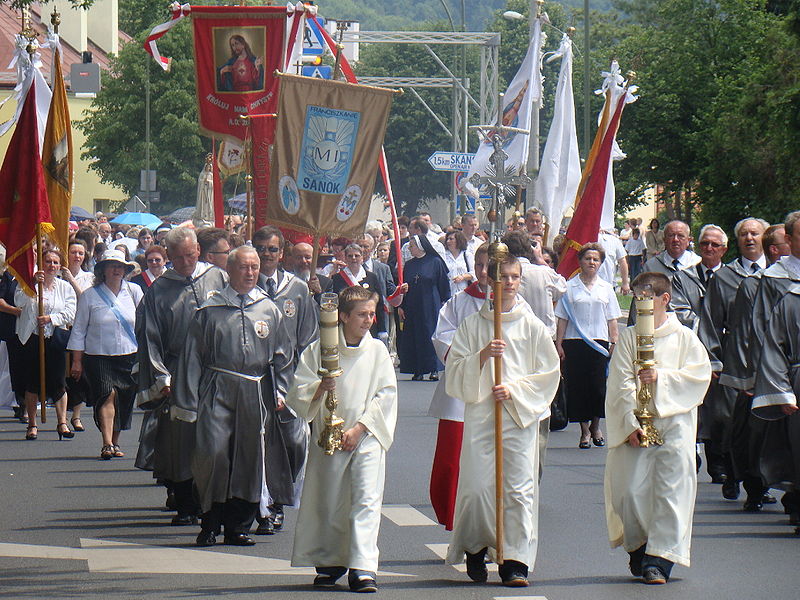
Corpus Christi procession in Poland in 2011.
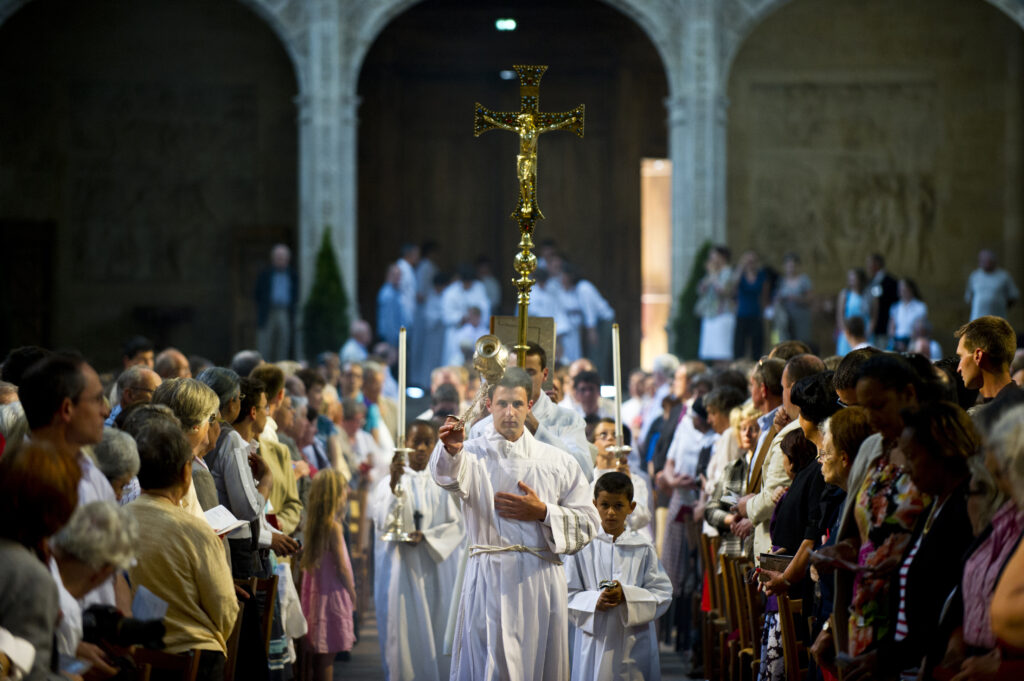
As liturgical parades, processions include processional crosses, torches, banners, incense and colorful vestments, both outdoors and indoors. These processions usually include the congregation as well as the choirs and clergy and are accompanied by psalms, litanies, and hymns. There is no doubt walking together singing responses to psalms and litanies and refrains to hymns engages worshipers bodily in the liturgy and promotes bonding among the participants.
McNeill’s thesis about “keeping together in time” applied to liturgical processions is facilitated with the use of metrical hymnody. The best processional hymns are those that provide a steady beat and a repeating refrain (e.g., “All Glory, Laud, and Honor” on Palm Sunday, “Hail, Thee, Festival Day” in the Ralph Vaughn Williams setting on Easter, Ascension, and Pentecost), so that people can walk without having to read texts and are able to join in singing the repeating refrain. Practical question: how do you enable a strung out procession to not get out of tempo from beginning to end. Answer: you place choir members with percussive instruments like handbells or drums sounding the beginning of each measure. Trumbones and Trumpets can lead the procession. The organ doesn’t join in until the procession begins entering the church building and stays with the tempo that has been established.
I would also note that the relatively recent introduction of projection screens to replace hymnals is useless in processions involving the congregation because the screens are not visible to the marchers. Hymnals are not very helpful either because people need to see where they are stepping. Repeating refrains that are easily memorized are helpful for congregational participation. Liturgy with synchronous movement is a powerful way to engage all the worshipers bodily, including children.
Orthodox procession
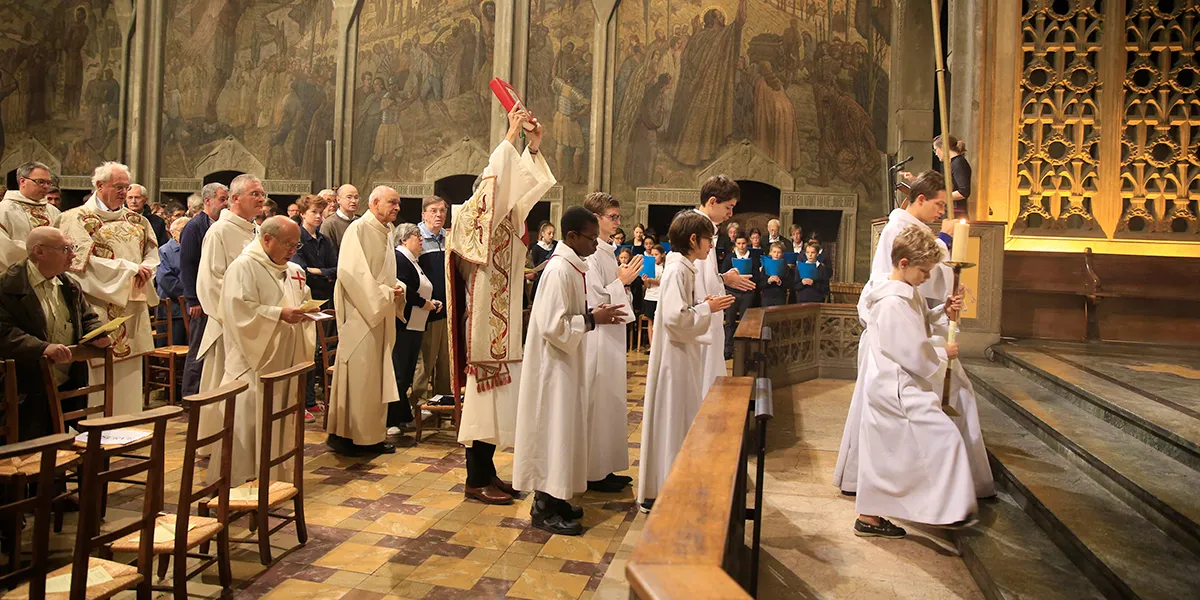
Liturgy is best performed when it is in motion. Even indoors the historic liturgy includes an entrance procession, a gospel procession, an offertory procession, a communion procession, and an exit procession. If there is a baptism there is a procession to the font or pool. In these processions, members of the congregation can be involved as well as the ministers and choirs. But even if the ministers and choirs are processing or marching on our behalf, we come to understand Orthodox theologian Alexander Schmemann’s point that the Eucharistic liturgy is “a journey into the dimension of the kingdom of God.” To be on a journey we have to get out of our seats and begin moving together. It is a powerful liturgical experience.
Pastor Frank.