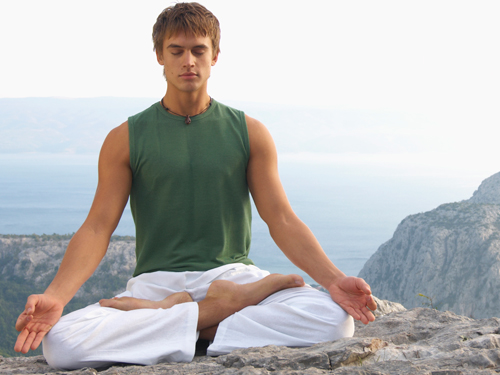
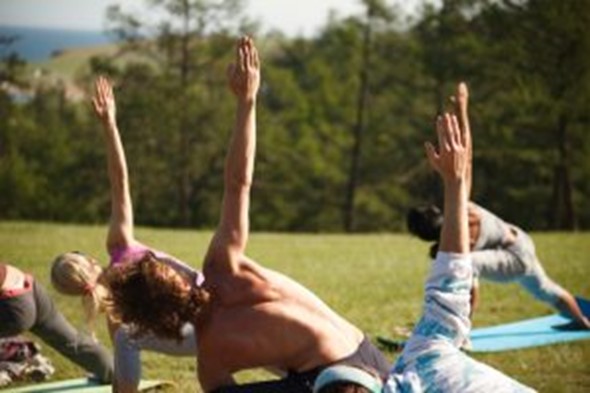
With millions of people practicing yoga, yoga could be a mighty force for raising awareness of our relationship to the natural world. Teachers should find ways to get their classes outdoors, like this Earth Day class at Hays State University in Kansas.

Yoga taps into the cosmological elements of fire (sun), air (wind), earth, and water, as well as the element of space (ether), about which I have written articles on this blog. Practicing yoga naked outdoors enables us to feel these elements more directly.
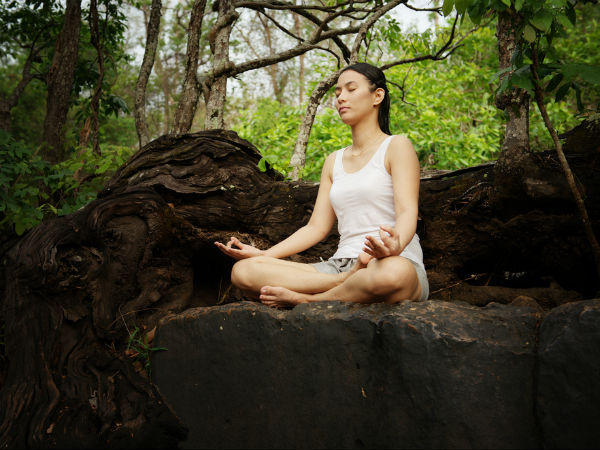
Part of reconnecting with Earth is reconnecting with our own bodies. We can feel our own bodies better if we are connecting with the nature of which we are a part—feeling beneath us both the hardness and the softness of Earth that supports us in space. The body organ that relates to the sense of touch is skin. It is our most sensitive organ. It feels differences in surfaces and temperatures, textures and vibrations, dryness and wetness. In these ways we are touching Earth and Earth is touching us.

Some yoga practices relate to the five elements of earth, air, fire, water, and space (ether) in the yoga cosmology as we experience them within our bodies — the earth that grounds our practice and provides stability, the air that we breathe in as uplifting energy and exhale as we settle into our posture, the fire that transforms matter within our digestive system as we do abdominal twists, the water that flows throughout our body enabling a flowing movement from one posture to another, the space that opens up our central axis as we stretch in different directions. Yoga has sought to help students sense these elements working within our bodies.

Yoga can cultivate an “enlightened” attitude about our relationship to Earth that would encourage many of its millions of practitioners to find projects big and small that they can become a part of. Maybe one type of action yoga could undertake is for several yoga studios to have a combined outdoor class and after a concluding Earth meditation disperse everyone through the park or the beach or along rural roads to pick up trash and properly dispose of it. Earth Day’s emphasis should motivate us to give constant attention to a clean and healthy environment.

Unfortunately, even if the yoga business was of a mind to get involved in environmental projects, it lacks the organizational mechanism to engage in clean-up projects such as churches and religious groups are able to provide. Canadian yogi Matthew Remski has been a singular voice calling for more social activism from the yoga community. He has even suggested that every yoga studio should be a soup kitchen. With all due respect to Remski, who has important things to say about the real needs of modern householder yogis versus the renunciate tradition that was the basis of Patanjali’s Yoga-sutras, I don’t see modern Western yoga developing a social cohesion that would promote social or environmental activism. But what yoga can do on the basis of its long philosophic tradition is help its practitioners to recover the connection between the human body and the body of Earth, like this Indian yogi who is doing a pigeon pose.

Meditation
The relationship between our yoga practice and nature could be the subject of a meditation in the natural world while in a natural state, connecting with Earth and the whole cosmos, sensing our participation in it, and being grateful for its benefits to us humans. This exercise, repeated over time, can form in us a clearer sense of our stewardship of creation. Contemplation can lead to action. They are not mutually exclusive.
Pastor Yogi Frank